


Understanding the Exposome: The Silicone Wristband—A Revolution in Measuring Our Chemical Exposure
We’ve all heard of our genome—that genetic “ID card” inherited from our parents that influences our health and our predisposition to certain diseases. Yet genetics alone accounts for only a small fraction of modern chronic diseases. To understand the other half of the equation, scientists are now turning their attention to an entirely different concept: the exposome.
Every day, we breathe in, ingest, and come into contact with thousands of synthetic and natural chemicals. From pesticide residues on our plates to flame retardants in our couches, not to mention car exhaust and phthalates in our cosmetics, our bodies are constantly under strain. But how can we make sense of this invisible cocktail? And above all, how can we accurately measure the pollution to which each of us is actually exposed on a daily basis?
What is the exposome?
The term “exposome” was first coined in 2005 by researcher Christopher Wild, then director of the International Agency for Research on Cancer (IARC). It refers to the totality of environmental exposures an individual is subjected to throughout their lifetime, from conception to death.
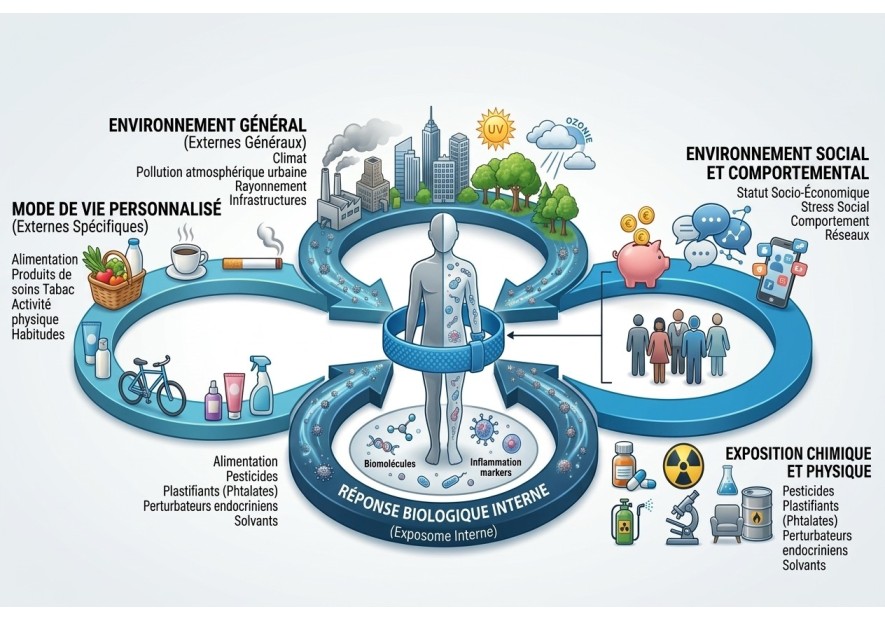
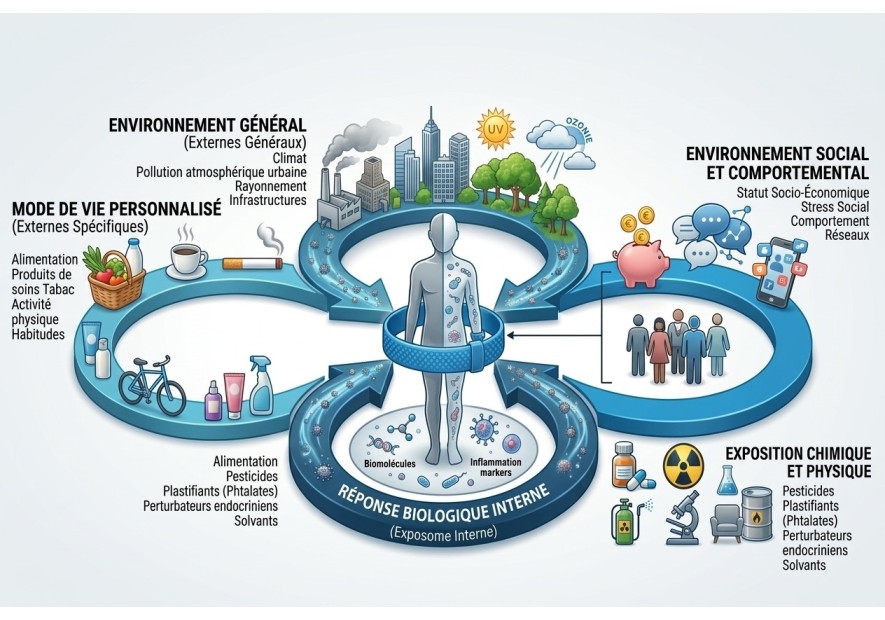
To help you visualize it, think of the exposome as the ledger of your environment. It encompasses three major areas of exposure:
1. The general external environment: Climate, urban air pollution, socioeconomic status, noise levels, and exposure to artificial light.
2. The specific external environment: Your daily lifestyle choices, including your diet, alcohol and tobacco use, the use of household products, cosmetics, and medications, as well as chemicals you are exposed to at work.
3. The internal environment: The way your body reacts to these external stressors (oxidative stress, inflammation, gut flora, or metabolism).
Today, epidemiologists agree that the exposome is responsible for more than 70% to 90% of chronic noncommunicable diseases, such as cancer, diabetes, obesity, cardiovascular disease, reduced fertility, and neurodegenerative disorders. Decoding this chemical cocktail has become a major public health challenge.
What are some ways to determine one's exposome?
Capturing the infinite number of molecules that surround us is a technological challenge. To determine the exposome, the scientific community has long relied on two main types of analyses, until a third method came along and shook up the field.
Biological Sampling (Biomonitoring)
Biomonitoring involves searching for traces of chemicals or their metabolites directly in samples taken from the human body.
Blood: It is the gold standard for measuring “persistent” pollutants—that is, those that accumulate in body fat or bind to blood proteins (such as lead, heavy metals, or certain older pesticides). However, a blood draw is an invasive procedure that requires medical personnel and provides only a “snapshot” of the pollutants circulating in the bloodstream at a given moment.
Urine: Very useful for analyzing “non-persistent” pollutants that are rapidly excreted by the kidneys, such as bisphenols or phthalates. The problem lies in its variability: concentrations in urine change considerably throughout the day depending on what you drank or ate two hours earlier.
Hair: Strands of hair act as a temporal black box. As hair grows (about 1 cm per month), it incorporates molecules present in the blood (pesticides, metals, medications). While this method provides a retrospective view spanning several months, it has significant limitations: exposure to shampoos, hair dyes, or outdoor air pollution can skew the results.
Environmental Sampling
Another approach involves analyzing the environment in which the person lives.
Air analysis: This method uses small vacuum pumps or stationary sensors placed in a room to filter out particles and capture gases (volatile organic compounds). Although highly accurate, these pumps are often heavy, noisy, and expensive. Furthermore, they measure the air in a fixed room but do not track a person’s individual movements.
Analysis of Household Dust: Dust that settles on floors and furniture accumulates numerous pollutants (flame retardants, phthalates). Vacuuming and analyzing it provides a good indicator of contamination in the home, but completely ignores exposure in the workplace or on public transportation.
The silicone wristband: the ideal tool for assessing your exposome on a daily basis
To overcome the limitations of blood draws and bulky air pumps, researchers at Oregon State University came up with an innovative idea: to use ordinary silicone wristbands as passive personal exposure samplers.
Silicone (or polydimethylsiloxane) is a polymeric material with a fascinating property: its porous, hydrophobic structure closely mimics the lipid layer of our skin cells. It acts like a molecular sponge capable of continuously adsorbing hundreds of volatile and semi-volatile organic chemicals.
When it comes to characterizing a person’s exposome, the silicone wristband offers unique advantages that explain its meteoric rise in scientific studies around the world:
Surprisingly simple (No biological sample required)
Nothing is simpler than slipping a silicone wristband onto your wrist. Unlike daily blood draws or urine samples, the wristband eliminates all stress, pain, and medical inconvenience. There’s no need for a nurse, freezer storage, or handling of complex biological samples. This simplicity makes it possible to conduct studies on thousands of people at the same time, as well as to include highly vulnerable populations for whom invasive sampling is difficult: young children, pregnant women, or the elderly.
A 7-day period that perfectly reflects daily life
While a blood test reveals only what is present at the exact moment of the draw, the silicone wristband records cumulative exposure over an extended period—ideally, 7 consecutive days. A full week allows for capturing an individual’s true weekly routine:
- Workdays at the office or in a factory;
- Daily commutes by public transportation or car;
- Weekend activities (gardening, DIY projects, housework);
- Sleeping at home.
The wristband accounts for both short-term exposure spikes and low-dose background radiation. At the end of the week, scientists obtain an average exposure profile of exceptional accuracy.
Simultaneous capture of multiple exposure channels
Worn on the wrist, the bracelet is at the heart of the interaction between your body and your environment. It intercepts molecules through two main pathways:
Inhalation: It is present in the air you breathe (both indoors and outdoors).
Skin contact: It comes into contact with your skin and absorbs substances found on surfaces (furniture, tools) or contained in your cosmetics and skincare products.
Total mobility
Odorless, durable, and discreet, the silicone wristband goes with you absolutely everywhere: in the shower, while exercising, in bed, at work, or when you're on the go. It requires no power source, no batteries, and makes no noise.
Toward Personalized Preventive Medicine
Understanding our exposome is the first step toward regaining control of our environmental health. Thanks to silicone wristband technology, scientific research now has a window into the invisible. By precisely identifying the molecules that surround us every day—phthalates, pesticides, flame retardants, and combustion residues—we can change our habits, clean up our homes, and steer public policy toward safer choices. The silicone wristband has achieved this remarkable feat: transforming a cutting-edge measurement tool into an accessory that’s as simple as can be.
