

Comment sont analysés les COV dans votre air intérieur ?
On average, we spend more than 80% of our time in enclosed spaces: homes, offices, schools, or vehicles. Yet indoor air is often more polluted than outdoor air. Among the many invisible air pollutants that affect our daily environment, Volatile Organic Compounds (VOCs) play a major role. Understanding their sources and conducting a thorough VOC analysis is an essential step in protecting your health and improving the air quality in your home.
Que sont les Composés Organiques Volatils (COV) ?
Les COV forment une vaste famille chimique de molécules contenant du carbone, caractérisées par une haute volatilité à température ambiante. Cette propriété physique leur permet de s'évaporer très facilement dans l'air depuis des sources liquides ou solides, s'infiltrant ainsi sans effort dans nos espaces de vie.
La diversité des COV est immense, mais plusieurs sous-familles emblématiques sont particulièrement surveillées dans les logements :
Les hydrocarbures aromatiques (BTEX) : Le Benzène, le Toluène, l'Éthylbenzène et les Xylènes proviennent principalement des carburants, des fumées de combustion (tabac, bougies, encens) ainsi que de certains revêtements. Le benzène est notamment classé cancérigène avéré.
Les solvants chlorés : Le trichloroéthylène et le perchloroéthylène sont largement utilisés pour le dégraissage industriel, le nettoyage à sec des textiles et dans la composition de certains produits de bricolage ou décapants.
Les hydrocarbures : Le décane et le undécane sont des alcanes lourds fréquemment émis par les parquets, les parquets vitrifiés, les cires, les colles d'ameublement ou les dérivés du pétrole employés dans les peintures synthétiques.
L'exposition prolongée à ces molécules peut engendrer des irritations des voies respiratoires, des maux de tête, des nausées, voire des pathologies chroniques plus graves comme des cancers ou des troubles neurologiques lorsque les concentration dépassent les valeurs de référence sanitaires.
Le capteur Scan4Air : le rôle clé du charbon actif
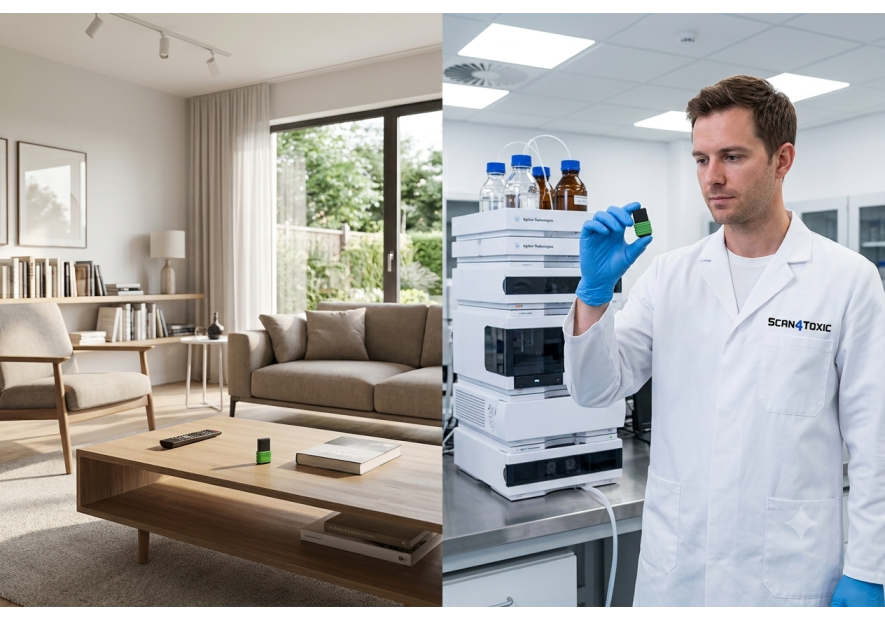
Pour effectuer une analyse des COV représentative et précise, la phase de prélèvement sur le terrain est déterminante. Le capteur utilisé par Scan4Toxic est spécifiquement conçu pour capter ces molécules volatiles présentes dans l'air ambiant.
Le cœur de ce dispositif repose sur un matériau absorbant d'une grande efficacité : le charbon actif. Grâce à sa porosité extrêmement élevée et à sa surface spécifique considérable, le charbon actif présente une forte affinité chimique avec les substances organiques. Lorsque l'air circule autour ou à travers le capteur, le charbon actif piège et emprisonne efficacement les molécules de COV présentes dans la pièce. Ce processus garantit la fixation fidèle des polluants pendant toute la durée de la mesure, sans dégradation du prélèvement.
Laboratory Preparation: Chemical Desorption
Once the sensor has been exposed and returned to the testing laboratory, the first step in the analysis is to extract the trapped compounds.
To achieve this, activated carbon is brought into contact with a specific organic solvent to induce chemical desorption. Under the influence of the solvent, the attractive forces holding the pollutants to the porous surface are broken. This chemical desorption is quantitative: virtually all of the VOCs bound to the activated carbon are transferred in a precisely controlled manner into the liquid phase. After a meticulous filtration process to remove all solid charcoal particles, the clear extract containing all the pollutants is ready for analytical testing.
L'analyse par GC-MS : séparation, identification et quantification
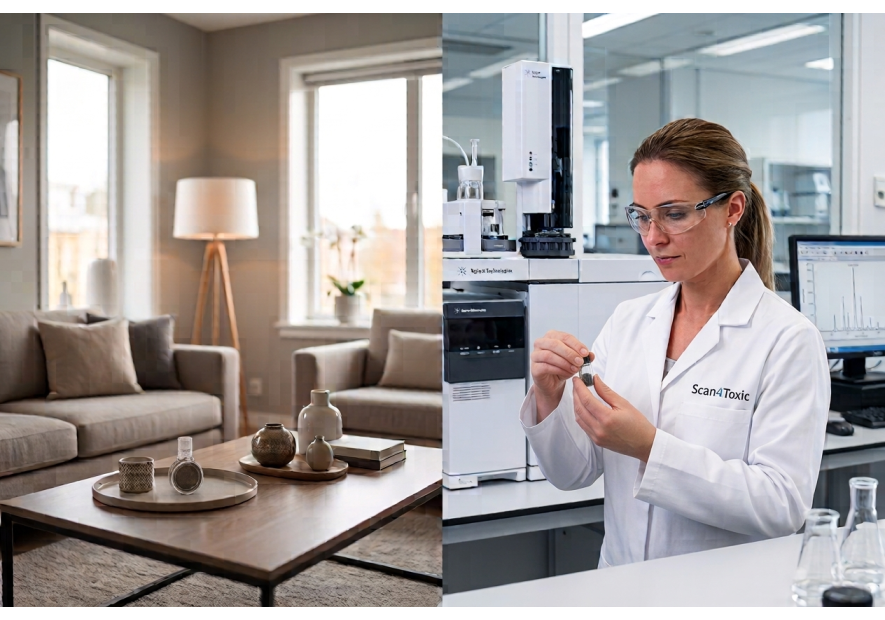
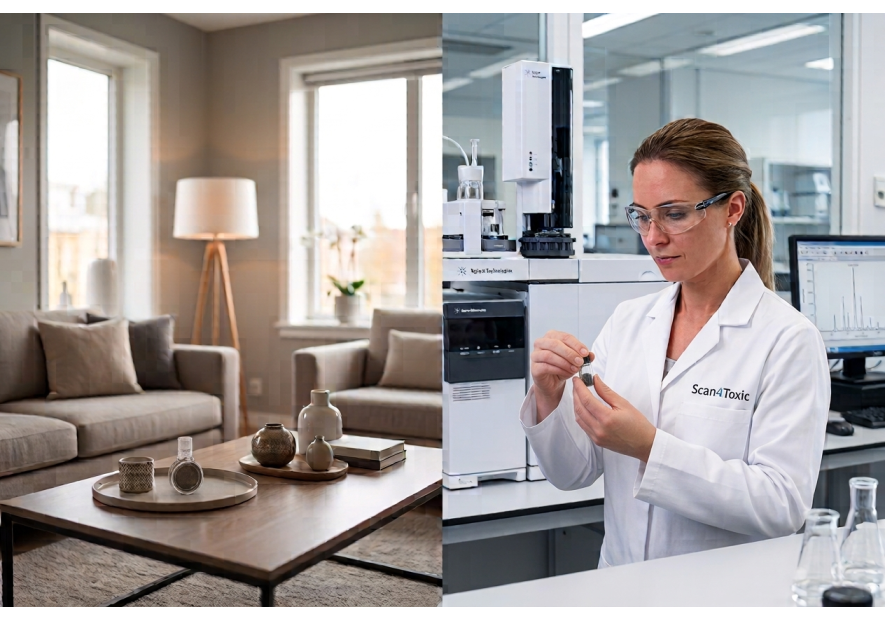
The liquid extract is then injected into a state-of-the-art instrument: a gas chromatograph coupled with a mass spectrometer (GC-MS). This combination of instruments is the gold standard in analytical chemistry for detecting volatile pollutants.
The Principle of Gas Chromatography (GC)
The sample is vaporized and then carried by a carrier gas through a capillary column. Depending on their chemical structure, molecular weight, and polarity, the various substances travel at different speeds. This step allows for the physical separation of each compound present in the initial mixture. At the column outlet, each pollutant appears as a “chromatographic peak.”
Accurate quantification
The relationship between the area of a chromatographic peak and the amount of material injected is strictly exact. By comparing the area of each peak with reference standards prepared at very precisely known concentrations, the laboratory measures the exact amount of each pollutant sampled.
Mass Spectrometry (MS)
Mass spectrometry is particularly well-suited for VOC analysis due to its extremely high sensitivity. As the molecules pass through the detector, they are ionized and fragmented. Each compound then produces a mass spectrum that constitutes a unique “spectral fingerprint.” This signature allows for the definitive identification of the molecule present (distinguishing trichloroethylene unambiguously from benzene or decane, for example), thereby eliminating any risk of false positives.
Reliable results interpreted in relation to health standards
The analytical method used by Scan4Toxic is extremely reliable and measures VOC concentrations in indoor air with very high precision, expressed in micrograms per cubic meter (µg/m³).
Once the analyses are complete, the data is provided to the client in the form of a comprehensive and informative report. To put the numbers into context, each measured concentration is directly interpreted in relation to reference values and exposure thresholds recognized by health authorities (such as ANSES or the High Council for Public Health).
Thanks to this clear assessment, you’ll know exactly what your indoor air quality is like and have the advice you need to eliminate the sources of pollution identified in your daily life.
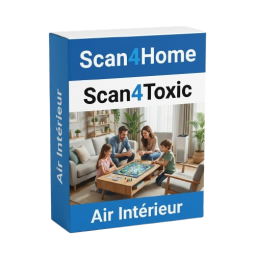
Scan4Home - VOC Scan4Home - VOC
Comprehensive testing kit to measure Volatile Organic...
Comprehensive testing kit to measure Volatile Organic Compounds (VOCs) in indoor air of homes or offices and to assess the indoor air quality. Measures over 30 VOCs. Indoor air contains many toxic chemicals, and testing it allows you to take steps to protect your health on a daily basis.
Price €199.00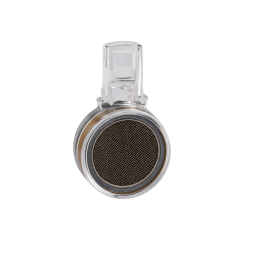
Scan4Air - VOC Sampler Scan4Air - VOC Sampler
The Scan4Toxic device allows you to collect an air sample to...
The Scan4Toxic device allows you to collect an air sample to assess indoor air pollution in your home caused by Volatile Organic Compounds (VOCs) or to assess occupational exposure in the workplace. Indoor air contains many toxic chemicals, and analyzing it enables you to take action to protect...
Price €49.00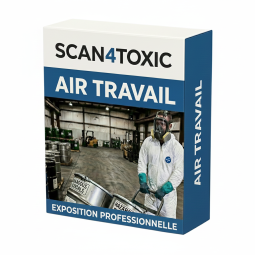

Scan4Air Kit - VOC Screening Scan4Air Kit - VOC Screening
Complete analysis kit for measuring air quality in workplaces...
Complete analysis kit for measuring air quality in workplaces and occupational exposure to VOCs. Exposure to VOCs can cause occupational diseases.
Price €499.00