



The PTS Wristband: Technological Innovation for Assessing Human Exposure to Pollution

Every day, we move through an invisible ocean of molecules. At home, on public transportation, or at work, our bodies are constantly interacting with a multitude of chemicals. For a long time, accurately measuring the exact amount of pollutants each of us absorbs has been a scientific challenge for researchers. Today, an innovative technology is changing the game in environmental health and prevention: the PTS (Personal Toxic Sampler) wristband. This device, deceptively simple in appearance—as it looks almost exactly like a piece of wrist jewelry—actually conceals fascinating molecular and biomimetic engineering.
A striking resemblance to human skin
To understand how the PTS wristband measures our exposure, we need to look at our own biology. Our skin is not an impenetrable shield; it is a porous, dynamic, living organ covered by a thin layer of lipids (fats) that protects us. However, this lipid barrier has the unique property of very easily attracting and absorbing molecules known as “lipophilic” that is, chemicals that have a natural affinity for fats.
The secret to how the PTS wristband works lies in the material it is made of. It is made from a very specific polymer that remarkably mimics the absorption properties of the outer layer of human skin. In other words, this polymer acts as an artificial chemical sponge or a true “skin substitute.”
When a person wears this sampler on their wrist, the device interacts with the environment in exactly the same way as the wearer’s skin. Pollutant molecules suspended in the air or those deposited on objects the wrist comes into contact with naturally dissolve and become trapped deep within the wristband's matrix, just as they would penetrate through our pores. The wristband “breathes” and absorbs the world around it at the same pace as we do.
The Main Benefits of a Personal Passive Sampler
The use of the PTS wristband offers unprecedented benefits for researchers and epidemiologists studying our environment:
A completely non-invasive method
Unlike blood or urine tests, which can be stressful, painful, and medically invasive, wearing a wristband is a completely harmless procedure. This approach makes it very easy to include young children, pregnant women, and vulnerable individuals in large-scale public health studies without causing resistance or apprehension.
Continuous, accurate measurement every day
A blood test provides only a snapshot of pollution levels in the body at the exact moment the needle pricks the skin. The wristband, on the other hand, is designed to be worn 24 hours a day, usually for an entire week. It accurately tracks fluctuations in exposure over the course of days and nights, providing a comprehensive picture of our chronic exposure.
Simultaneous capture of multiple exposure channels
Located on the wrist, it is constantly exposed to the air we breathe (the inhalation route) and comes into contact with our immediate environment (the skin contact route). It is therefore able to detect pollution from both of these exposure routes simultaneously.
A greatly simplified design process
This sampler, described as "passive," requires no batteries or mechanical pumps, makes no noise, and does not require complex storage conditions (such as freezing with dry ice) prior to analysis, unlike conventional biological samples.
A Specific Chemical Target: Semi-Volatile Organic Compounds
It is crucial to note that this sampler does not measure all existing pollutants (for example, it does not detect heavy metals). The PTS wristband is specifically designed and chemically optimized to capture a single major family of compounds that is particularly harmful to health: semi-volatile organic compounds (or SVOCs).
What is a semi-volatile organic compound?
These are medium-sized molecules that have the distinctive property of evaporating slowly at room temperature, rapidly transitioning from a solid or liquid state to a gaseous state before settling on dust or our skin. They can be found absolutely everywhere in our homes and gardens. Thanks to this bracelet, scientists are focusing exclusively on these semi-volatile organic compounds, which include:
Pesticides: fungicides, insecticides, or herbicides used in agriculture, for the maintenance of green spaces and also for domestic use.
Flame retardants: additives widely used in the foam of our sofas, mattresses, and the casings of our electronic devices.
Phthalates: plasticizers used to soften plastics (packaging) or to help fragrances last longer in our cosmetics.
Polycyclic aromatic hydrocarbons (PAHs): compounds produced by any form of combustion (exhaust fumes, cigarette smoke, grilled meat, and fireplace fires).
These semi-volatile, highly lipophilic organic compounds have a perfect chemical affinity with the sensor material, ensuring their complete absorption.
The lab's findings: chromatography and mass spectrometry
Once the evaluation week is over, the PTS wristband is stored in a sealed metal box and sent to a high-tech analytical chemistry laboratory. To “activate” the sampler, the extraction of pollutants begins with a bath in organic solvents. These solvents force the polymer to release all the semi-volatile organic compounds it has patiently accumulated.
The liquid resulting from this extraction is then injected into highly sophisticated instruments that always combine two major and complementary analytical techniques: chromatography and mass spectrometry.
Chromatography acts as a highly precise molecular sorter. By passing the sample through the chromatography column, the extremely complex mixture of pollutants is separated. This process allows each pollutant to be physically isolated one by one.
Mass spectrometry takes over immediately after the sample exits the chromatography column. Each molecule isolated by chromatography enters the mass spectrometer. The mass spectrometer then acts as a scale of unprecedented precision, measuring the exact mass of each molecular fragment. Every semi-volatile organic compound has a mass “fingerprint” that is strictly unique to it.
By combining chromatographic separation with definitive identification via mass spectrometry, the laboratory computer is able to provide a comprehensive list and the infinitesimal quantities of all semi-volatile organic compounds to which the wearer has been exposed. This perfect synergy between a biomimetic sampler and the ultra-sensitivity of analytical chemistry makes the PTS wristband the cornerstone of tomorrow’s environmental medicine.
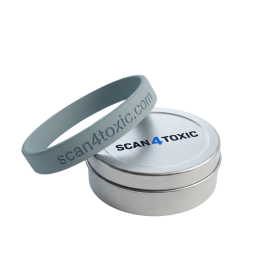
Scan4Health - PTS Wristband Scan4Health - PTS Wristband
This PST (Personal Toxic Sampler) Wristband developed by...
This PST (Personal Toxic Sampler) Wristband developed by Scan4Toxic is made from a highly adsorbent technological material. It effectively captures ambient pollution, and can be worn as a wristband to assess personal exposure to pollution. WARNING: This sampling kit does not include analysis of...
Price €29.00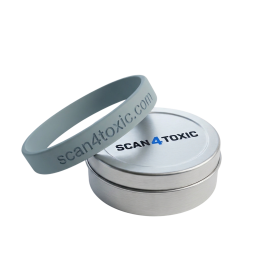
Scan4Health - Endocrine Disruptors - Fertility PTS Scan4Health - Endocrine Disruptors - Fertility PTS
Test kit with PTS Wristband to measure personal exposure to...
Test kit with PTS Wristband to measure personal exposure to the most common endocrine disruptors in our daily environment. The PTS wristband is made of a high-tech material with unique adsorbent properties that will capture the pollution to which you are exposed.
Price €149.00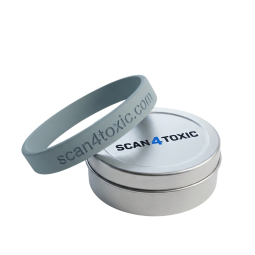

Scan4Health - Neurotoxins PTS Scan4Health - Neurotoxins PTS
Test kit with a PTS wristband to measure your personal...
Test kit with a PTS wristband to measure your personal exposure to the most common neurotoxic substances in our everyday environment. The PTS wristband is made of a high-tech material with unique adsorbent properties that capture the pollution you are exposed to.
Price €199.00