Décontamination après incendie : Comment valider scientifiquement vos interventions ?
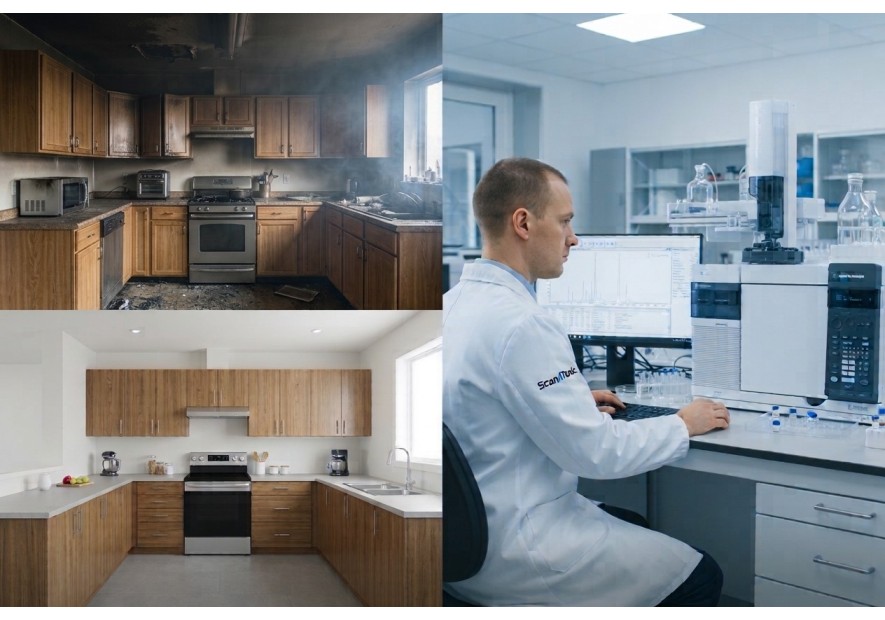
For a disaster restoration professional, post-fire decontamination isn’t limited to eliminating odors and scrubbing down walls. It’s a race against the invisible. While greasy soot and carbon deposits are your teams’ top priorities, the persistence of polycyclic aromatic hydrocarbons (PAHs) on surfaces represents the real health and legal challenge of your profession. Today, “clean to the naked eye” is no longer enough to guarantee the safety of occupants.
The Hidden Challenge of Post-Fire Decontamination: PAHs
During a fire, the incomplete combustion of various materials (plastics, wood, insulation) produces a mixture of toxic substances. Among these, PAHs are particularly dangerous. Persistent and often carcinogenic, they seep into the pores of materials and remain there long after cleaning with brushes and sprayers.
As an expert, you are held liable. Handing over a site where PAH residues exceed safety thresholds exposes future occupants to chronic risks. This is where metrology becomes your best ally in transforming a cleaning service into a true, certified post-fire decontamination process.
Why is it important to verify the effectiveness of post-fire decontamination?
Validation through chemical analysis is no longer just an option—it’s a major differentiator. In an increasingly demanding market, demonstrating that surfaces are safe allows you to:
Reassuring clients: Whether they are insurers, property managers, or individuals, a laboratory report provides indisputable proof of results.
Limit your liability: By documenting the final condition of the surfaces, you protect yourself against potential future claims related to lingering odors or health issues.
Optimize your protocols: If test results show traces of PAHs after the first pass, you can adjust your stripping techniques or cleaning agents.
Protecting Your Profit Margins: A decontamination project involving doubts or disputes poses a financial risk to your disaster recovery company.
The Scan4Work - PAH Surface Kit: The Industry Standard
To meet this need for precision, the Scan4Work - PAH Surface kit has established itself as the go-to solution for professionals in post-fire decontamination.
This kit is specifically designed to assess surface contamination. It measures the concentration of the 16 priority PAHs listed by the U.S. EPA (Environmental Protection Agency), thereby covering the broadest spectrum of post-fire toxic risks.
The benefits of the kit for your construction sites:
Easy sampling: You don't need to be a chemical engineer. The kit includes everything you need to take swab samples from surfaces measuring 50 x 50 cm.
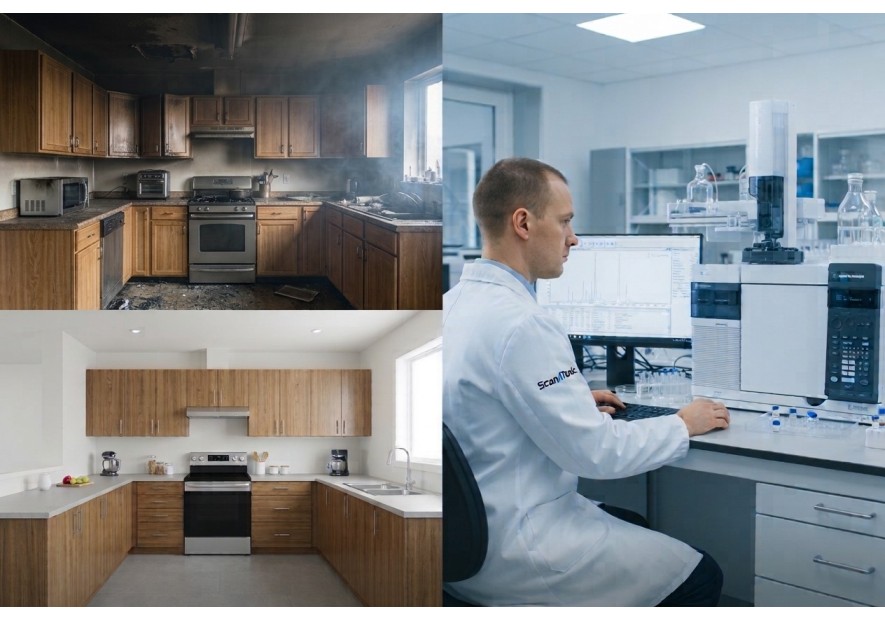
State-of-the-art analysis: Samples are sent to a specialized laboratory that uses chromatography coupled with mass spectrometry to identify and quantify each molecule to the nearest microgram.
Expert Report: You will receive a clear document comparing the results to the guideline values, which you can include directly in your project completion file.
Integrate Quality Control into Your Business Process
Successful post-fire decontamination requires a systematic approach. We recommend that professionals incorporate the Scan4Work kit into a three-step strategy:
Initial Assessment: To evaluate the extent of soot penetration and determine the most appropriate protocol (cryogenic cleaning, encapsulation, chemical stripping).
Active Cleaning Phase: Use of your standard equipment and products to remove visible deposits.
Final Validation: Sampling of treated areas to confirm that post-fire decontamination has met its health and safety objectives.
"Trust does not preclude oversight. In the aftermath of a fire, oversight is the only solid foundation for trust."
Get a head start
The post-disaster recovery industry is evolving. Requirements for Indoor Air Quality (IAQ) and chemical safety are driving service providers to enhance their expertise. By using Scan4Toxic solutions, you’re not just cleaning walls—you’re restoring the health and safety of a living or working environment.
Don't leave the quality of your post-fire decontamination to chance. Let science be the hallmark of your expertise and guarantee your clients an environment free of compromises.
Scan4Home - Fire Pollution Scan4Home - Fire Pollution
This testing kit allows you to measure the level of...
This testing kit allows you to measure the level of carcinogenic combustion residues in your indoor environment following a fire. Your dust sample is analyzed in a laboratory for Polycyclic Aromatic Hydrocarbons (PAHs).
Price €249.00
Scan4Dust - Dust Wipe Scan4Dust - Dust Wipe
The Scan4Toxic sampling device is used to collect a sample of...
The Scan4Toxic sampling device is used to collect a sample of dust deposited on a surface. Dust contains many toxic chemicals, and analyzing it can help you take steps to protect your health on a daily basis. This sampling kit does not include analysis of your dust sample. You must order an...
Price €29.00

Scan4Dust - HAP Lingette Scan4Dust - HAP Lingette
Complete test kit to assess the effectiveness of post-fire...
Complete test kit to assess the effectiveness of post-fire decontamination. Provides accurate and reliable measurements of PAH (polycyclic aromatic hydrocarbons) combustion residues, which are classified as carcinogens.
Price €199.00