


How is formaldehyde in your indoor air tested?
Formaldehyde is one of the most widespread and harmful chemical pollutants in our indoor spaces. Found in particleboard furniture, adhesives, varnishes, paints, and many household products, this gaseous compound continuously evaporates at room temperature. Given the health risks it poses—including respiratory tract irritation and its classification as a known human carcinogen—assessing its presence in our homes has become a major public health issue. But how exactly is a formaldehyde analysis conducted? From the sensor placed in your living room to the laboratory instruments, discover the rigorous scientific process used to measure this toxic substance.
Formaldehyde and the chemical family of aldehydes
To understand the analytical methodology, we must first define the chemical nature of this pollutant. Formaldehyde (or methanal) belongs to the chemical family of aldehydes. These are volatile organic compounds (VOCs) characterized by the presence of a carbonyl group bonded to at least one hydrogen atom. Because of this specific molecular structure, aldehydes—just like their related compounds, ketones—are highly reactive molecules.
In indoor environments, formaldehyde is the lightest, most volatile, and most abundant member of this family. Its high chemical reactivity—which makes it harmful to human mucous membranes during chronic exposure—is precisely the property exploited in the laboratory to trap and quantify it with extreme sensitivity during a formaldehyde analysis.
The principle behind formaldehyde capture: the chemical reaction with DNPH
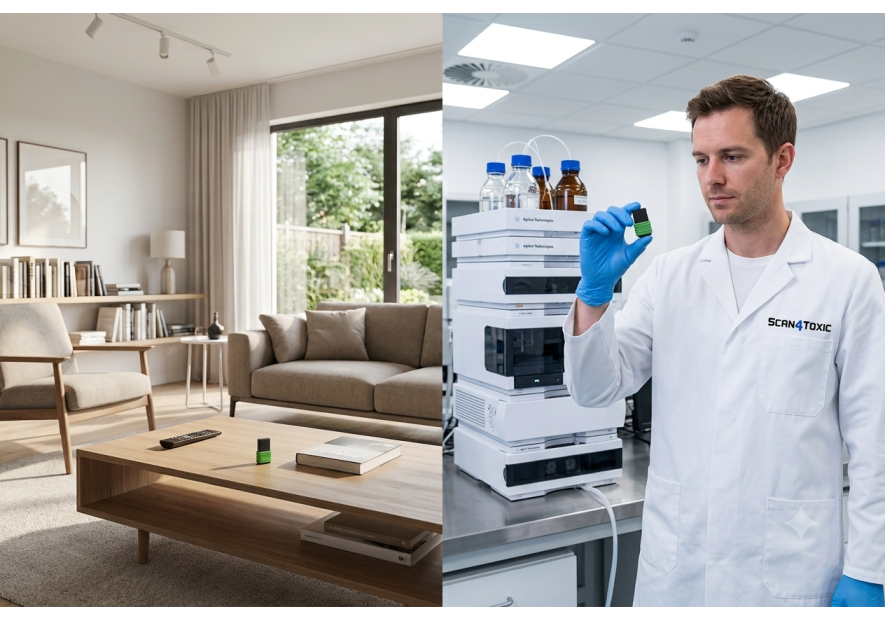
The sampling stage is the foundation of a successful measurement. The Scan4Air passive sensor used by Scan4Toxic is specifically designed to sample formaldehyde, as well as all aldehydes and ketones present in the ambient air.
This sensor contains a porous support impregnated with a highly specific chemical reagent: DNPH (di-nitrophenylhydrazine). The operation of this device is based on a highly precise chemical reaction:
A quantitative and irreversible reaction: As soon as the formaldehyde molecules suspended in the air come into contact with the sensor reagent, they react spontaneously and completely with DNPH.
The formation of stable hydrazones: This condensation reaction converts gaseous, volatile formaldehyde into a solid, highly stable compound called a hydrazone (more specifically, formaldehyde-2,4-dinitrophenylhydrazone).
This chemical derivatization process allows for the selective and permanent capture of volatile substances in the aldehyde and ketone families. It ensures that the trapped pollutants do not degrade or evaporate during transport from the sensor to the analytical laboratory.
From the Sample to the Lab: Chemical Desorption
Once the exposure period in the home has ended, the sensor is sealed and sent to the testing laboratory. The second phase of the formaldehyde analysis can then begin: chemical desorption.
Removal of the sample holder: In a controlled atmosphere, the sample holder containing the formed complexes is carefully removed from the sensor housing.
Exposure to an organic solvent: The substrate is immersed in a measured quantity of a high-purity organic solvent (such as acetonitrile).
Rapid and quantitative desorption: The solvent ensures the complete chemical desorption of the hydrazones formed during air sampling. This transfer from the solid phase to the liquid phase occurs rapidly, completely, and without any loss of material.
Extract Filtration: The resulting liquid solution is filtered through a micrometer-grade membrane to remove any specific impurities, ensuring a perfectly fluid and purified extract for the injection step.
Chromatographic Analysis and Precision Quantification
The final and decisive step involves the separation and quantification of the molecules contained in the filtered extract. For this phase, formaldehyde analysis relies on a gold-standard analytical technique: high-performance liquid chromatography coupled with UV spectrophotometric detection (HPLC-UV).
Separation by liquid chromatography
The liquid extract is injected into a chromatographic column through which a high-pressure solvent stream flows. Depending on their chemical affinity with the column’s stationary phase, the various hydrazones move at different rates. This fundamental principle of chromatography allows for the complete separation of formaldehyde hydrazone from hydrazones derived from other aldehydes (such as acetaldehyde or acrolein) and from various ketones (such as acetone).
Detection by UV Spectrophotometry
At the column outlet, a spectrophotometric detector measures the absorption of ultraviolet light by the hydrazone complexes at a specific wavelength.
Strict Quantification
The instrument generates a chromatogram in which each separated substance appears as a "peak." Quantification is based on a fundamental physical principle: the area under the chromatographic peak is strictly proportional to the amount of formaldehyde present in the sample. By comparing this area with calibration curves established using standard samples whose concentrations are known with very high precision, scientists determine the exact mass of the captured pollutant.
Reliability of Results and Interpretation
The analytical method used by Scan4Toxic has a proven track record of reliability. It measures the concentration of formaldehyde, aldehydes, and ketones in indoor air with extreme sensitivity, typically expressed in micrograms per cubic meter (µg/m³).
The results of this formaldehyde analysis are then presented in a clear and well-structured diagnostic report. To ensure that this technical data provides genuine health-related value, the measured concentrations are interpreted and compared to reference values recognized by health authorities:
- The Indoor Air Quality Guidelines (VGAI) developed by ANSES (the French Agency for Food, Environmental and Occupational Health & Safety).
- Benchmark data from the national campaigns conducted by the Observatory of Indoor Environments (OQEI).
Thanks to this rigorous approach, residents have access to indisputable data to assess the safety of their homes and implement personalized remediation recommendations to sustainably reduce their exposure to chemical pollutants.
Scan4Home - Aldehydes Scan4Home - Aldehydes
Complete Indoor Air test kit to measure aldehydes and ketones...
Complete Indoor Air test kit to measure aldehydes and ketones in in indoor air of homes or offices and to assess the indoor air quality. Measures over 10 aldehydes and ketones. Indoor air contains many toxic chemicals, and testing it allows you to take steps to protect your health on a daily basis.
Price €199.00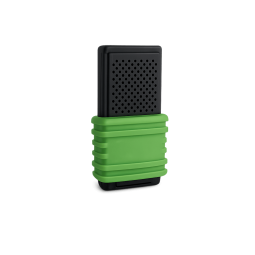
Scan4Air - Aldehyde Sampler Scan4Air - Aldehyde Sampler
The Scan4Toxic device allows you to collect an air sample to...
The Scan4Toxic device allows you to collect an air sample to assess indoor air pollution in your home caused by Volatile Organic Compounds (VOCs) from the aldehyde family, or to assess occupational exposure in the workplace. Indoor air contains many toxic chemicals, and analyzing it allows you to...
Price €49.00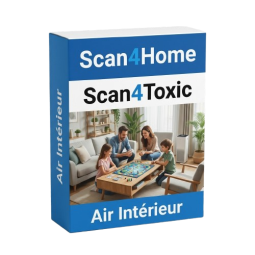

Scan4Home - Indoor Air Scan4Home - Indoor Air
Complete test kit to measure Volatile Organic Compounds (VOCs)...
Complete test kit to measure Volatile Organic Compounds (VOCs) and aldehydes in indoor air in homes and offices. Measures over 60 VOCs and aldehydes. Indoor air contains many toxic chemicals, and testing it allows you to take steps to protect your health on a daily basis.
Price €299.00